
Quick summary: Deep cleaning a kitchen works best in a fixed order, from clutter to high surfaces to appliances to floors. After the reset, a daily, weekly and monthly routine keeps it from building back up.
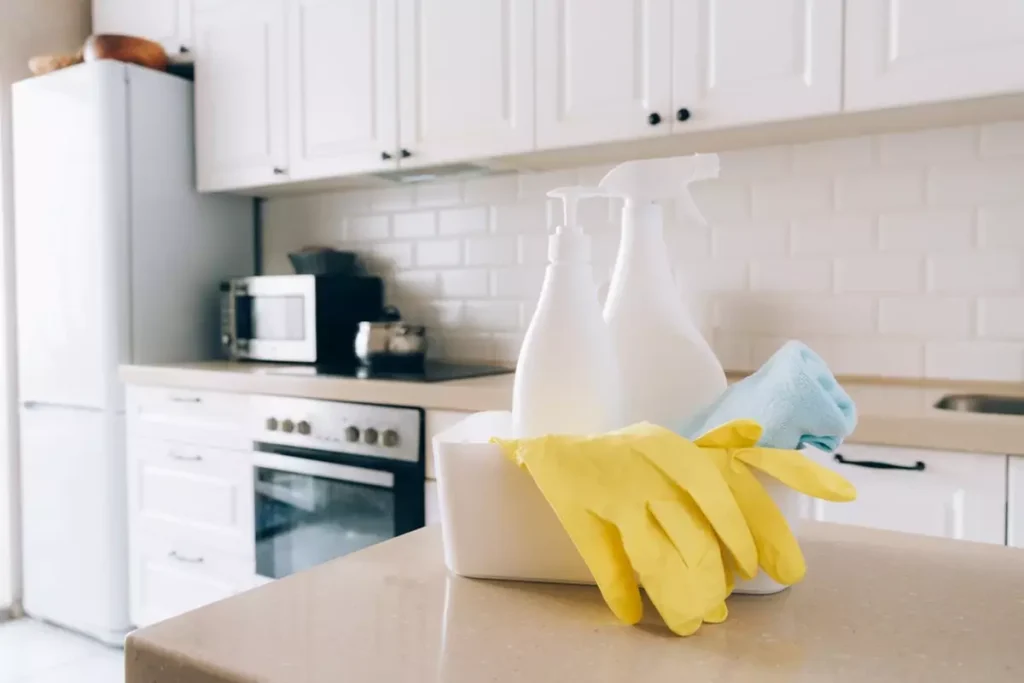
- Clear the counters completely before you clean anything.
- Work top to bottom so nothing gets cleaned twice.
- Match the product to the countertop, since acid etches marble and granite.
- San Diego’s very hard water is why stainless steel and glassware spot so fast.
- Dishes daily, floors and fridge weekly, drains and boards monthly.
A kitchen works harder than any other room. Coffee in the morning, lunches, dinners, pet bowls, and the small spills nobody notices at the time. Even with counters wiped most days, grease and crumbs collect in places a wipe never reaches.
Below is the order to deep clean a kitchen properly, how to handle different countertop materials, and the routine that holds the result in place afterwards.
Why Deep Cleaning a Kitchen Is Worth the Afternoon
A quick tidy keeps a kitchen presentable. However, it leaves the grease film on the range hood, the crumbs under the toaster and the buildup in the drain exactly where they are.
A deep clean kitchen reset reaches all of that. Because the buildup is fully gone rather than smoothed over, it takes considerably longer to return, so your daily upkeep gets easier for weeks.
Step 1: Clear the Space
Every deep clean kitchen session starts the same way. Take everything off the counters: mail, keys, small appliances, oils, pantry items, and pet bowls if they sit near your work area.
Then throw out expired food and empty packaging. Clearing first is not just tidiness, since a bare counter shows you the crumbs, spills and grease you would otherwise clean straight past.
Step 2: Work From the Top Down
Start high and finish low. That means light fixtures, ceiling fan blades, upper shelves and the tops of cabinets, which collect a surprising amount of greasy dust in a kitchen.
Then move down through wall marks, the backsplash, countertops and lower cabinets. Finish with the floor. Consequently nothing you have already cleaned gets dusted on from above.
Step 3: Clean Cabinets Inside and Out
Kitchen cabinet doors collect fingerprints and cooking splatter, especially around handles and anywhere near the hob.
Wipe the doors first, then concentrate on pulls, edges and lower panels where hands land most. If the insides need doing, empty them in small sections rather than all at once, so the job stays manageable.
Use a cleaner suited to the finish and do not soak the surface. Painted and veneered cabinets in particular do not forgive standing water along the seams.
Step 4: Refresh the Small Appliances
Small kitchen appliances hide more than people expect, so this step repays the effort.
For the microwave, take the turntable out and wash it separately, then wipe the interior walls, ceiling, door and seals. Dried splatter around the door edge is the part most often missed.
Empty the toaster crumb tray, then wipe the outside once it is cool and unplugged. Coffee makers, air fryers and blenders all benefit from the same treatment, so clean the removable parts as directed and wipe the housings.
Step 5: Tackle the Stove, Range Hood and Oven
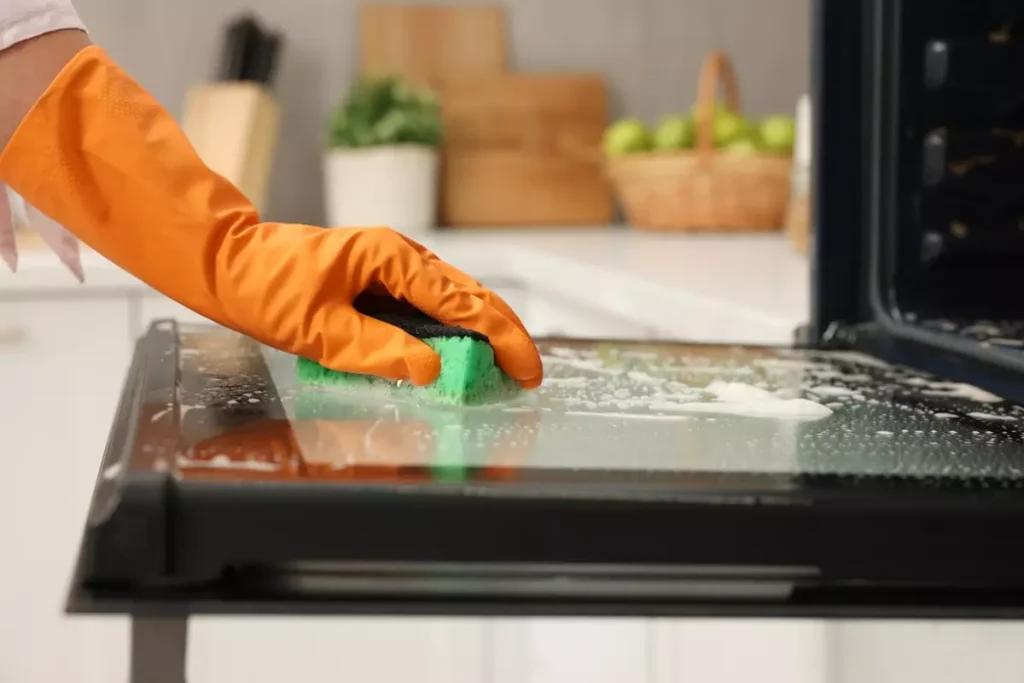
Cooking surfaces need the most attention in any kitchen deep clean.
Start with the stovetop. Clear loose debris, wipe the spills, and work carefully around knobs and control panels.
Then do the range hood, including the underside where grease actually settles. If the filter comes out, check whether yours is washable or needs replacing, because a clogged filter stops the extraction working at all.
For the oven, remove loose debris first, then use the method your appliance calls for. A baking soda paste left to sit handles most baked-on residue without harsh chemicals. Pay attention to the door glass, the racks and the edges.
Step 6: Disinfect High-Touch and Food Prep Areas
Once the visible grime is gone, disinfect. Order matters in a kitchen, since disinfectant applied over grease mostly just sits on the grease.
Focus on sink handles, fridge pulls, cabinet knobs, appliance buttons and any counter used for food preparation. Choose a product suited to the surface and follow the label, particularly the contact time, which is how long the surface must stay wet to actually work.
Step 7: Deep Clean the Sink and Drain
The sink handles food scraps and rinsed dishes all day, so it deserves careful attention.
Clean the basin, the faucet, the drain and the counter around it. Buildup collects behind the faucet and along the sealant edges where moisture lingers.
For the drain itself, baking soda followed by vinegar loosens what has collected in the pipe. If you have a garbage disposal, freshen it as the manufacturer directs. Finish by wiping soap bottles, sponge holders and the dish rack, which are usually dirtier than the sink.
Step 8: Floors, Corners and Grout
Kitchen floors carry the evidence of everything else. Sweep or vacuum first, including along baseboards, under cabinet overhangs and behind movable bins or stools.
Then mop with something suited to your flooring. If the grout looks dull, work a grout-safe cleaner in with a small brush, section by section. Test anything stronger somewhere out of sight first.
Step 9: Reset the Room
Put back only what you actually use daily. Replace the dish towels, refill the soap, return the pet bowls to a clean spot.
A deep clean kitchen that is then left cluttered stops feeling clean within days, so this last step protects the eight before it.
Countertop Care by Material
This is where most advice on how to deep clean a kitchen goes wrong, because the right product depends entirely on the surface.
Marble and granite. Use a mild, non-acidic cleaner. Vinegar, lemon and many general sprays etch natural stone, and etching is physical damage to the surface rather than a stain, so it does not wipe off or polish out easily.
Quartz and solid surface. Warm water and a mild detergent handle almost everything. Avoid abrasive pads, which dull the finish permanently.
Wood and butcher block. Sanitise with vinegar, then apply food-grade mineral oil to stop the wood drying and cracking. Oiling every month or two is what keeps a board from splitting along the glue lines.
Stainless steel. A microfibre cloth with a stainless cleaner leaves it fingerprint-free. Work along the grain rather than across it.
Glass and tile backsplash. A streak-free cleaner and a dry microfibre finish. Grease carries further up a backsplash than most people clean.
One more worth knowing: vacuum the condenser coils behind or beneath your fridge once or twice a year. Dusty coils make the appliance work harder and run less efficiently, and almost nobody does it.
Hard Water in San Diego Kitchens
There is a local reason your stainless steel and glassware spot so quickly here.
The City of San Diego reports tap water averaging 16 to 18 grains per gallon, or 272 to 284 ppm. Anything over roughly 10.5 grains counts as very hard, so local water sits well into that range.
In a kitchen that shows up as spotting on the sink and taps, a chalky film on glassware out of the dishwasher, scale inside kettles and coffee makers, and a dull haze on stainless steel that returns days after cleaning.
Descaling kettles and coffee makers every month or two deals with most of it. A rinse aid helps the glassware. Drying the sink and taps after use sounds fussy, though it is the single thing that makes the biggest visible difference. The same water affects your bathroom even more noticeably.
Your Daily, Weekly and Monthly Kitchen Cleaning Routine
A deep clean kitchen reset only lasts if something holds it in place. Here is the cadence that does.
Daily
- Wash the dishes the same day. It is tempting to leave them, but a sink of dishes multiplies overnight and breeds bacteria while it waits.
- Rinse the sink afterwards, clearing any food caught in the drain.
- Wipe the counters. A microfibre cloth lifts more than a paper towel and will not scratch the surface.
- Deal with spills immediately, particularly on stone.
Weekly
- Sweep or vacuum the whole floor, corners included.
- Mop, especially if anything has been spilled or tracked in.
- Check the fridge for anything spoiled or past its date. Doing this weekly also stops you rebuying what you already have.
- Wash dish cloths and tea towels.
Monthly
- Clear the drains. Baking soda followed by vinegar loosens what has collected, and doing it monthly is far cheaper than a plumber.
- Oil wooden cutting boards to keep them from drying out and splitting.
- Sharpen the knives. A sharp knife slips less, so this is a safety task as much as a maintenance one.
- Descale the kettle and coffee maker, which local water makes necessary more often than the manuals assume.
Every three to six months
- Clean the fridge properly, shelves out and condenser coils vacuumed.
- Reorganise the cabinets and check dates on spices and baking goods.
- Run a full deep clean using the nine steps above.
A written house cleaning schedule makes this far easier to actually follow, and our spring cleaning checklist covers the kitchen alongside every other room for the annual reset.
When to Bring in Help
Parts of a deep clean kitchen session are genuinely unpleasant. Ovens, range hood filters and the gaps beside appliances take time and the right products.
Our deep cleaning service covers the full kitchen reset, and oven and fridge interiors are available as add-ons because those two are what people most want handed over. If keeping on top of it is the harder part, recurring cleaning fits better than a one-off.
Kitchen Cleaning FAQs
Here are the questions people ask most about how to deep clean a kitchen.
How do you deep clean a kitchen step by step?
Clear the clutter, then work top to bottom. Cabinets, small appliances, stove and oven, then disinfect high-touch surfaces, then the sink, then the floors. Reset the room last.
What order should you clean a kitchen in?
High to low, and dry work before wet. Counters before floors, since crumbs and dust fall during the earlier steps.
How long does it take to deep clean a kitchen?
Three to five hours to deep clean a kitchen of average size, depending on how much buildup there is. The oven and the cabinet interiors take the longest.
How often should you deep clean a kitchen?
Every three to six months, with daily and weekly upkeep in between. Kitchens that get heavy cooking use sit at the shorter end.
What is the best way to clean grout?
A grout-safe cleaner and a small brush, worked in short sections, then wiped. Let the product sit rather than scrubbing harder, and test stronger products out of sight first.
Can I use vinegar on kitchen countertops?
On quartz, laminate and stainless steel, yes. On marble, granite and other natural stone, no, because the acid etches the surface permanently.
Why does my glassware come out of the dishwasher cloudy?
Hard water. San Diego’s supply is very hard, so mineral deposits leave a film. A rinse aid and periodic descaling of the dishwasher both help.
What do most people forget when cleaning a kitchen?
Range hood filters, the tops of cabinets, fridge condenser coils and the drain. None of them look dirty from where you normally stand.
Book a Kitchen Deep Clean in San Diego
A deep clean kitchen reset is a few hours of work, and the routine afterwards is what makes it worth doing.
Presto Cleaning has cleaned San Diego homes for over a decade, across Hillcrest, Mission Hills, North Park, Normal Heights, Bankers Hill, South Park, Talmadge, University Heights and the surrounding service areas.
Call 619-366-0886 for a free quote, or book a fifteen minute walkthrough.














How did you hear about us?
Pleas let us know how you heard of us
to improve our marketing