
Quick summary: A deep clean removes the buildup that daily wiping leaves behind. Work top to bottom, let products sit instead of scrubbing harder, and treat hard water separately because that is what dulls most bathrooms.
- Clear the room first, then work from the highest surfaces down to the floor.
- Give every product time to sit, since dwell time does the work scrubbing cannot.
- Grout, showerheads and glass doors hold the most buildup and show it most.
- San Diego water is very hard, so mineral scale returns faster here than elsewhere.
- Dry surfaces at the end, because water left to evaporate is what leaves the spots.

A bathroom can look tidy and still feel stale. Wiping the counter every few days keeps the surface presentable, yet it never reaches the film on the glass, the scale in the showerhead or the grime sitting in the grout.
A deep clean reaches all of it. Below is the order to work in, what to do at each step, and why bathrooms here need slightly different treatment.
Why a Deep Clean Beats a Quick Wipe
Your bathroom deals with constant moisture, soap residue and heavy daily use. Those layers build slowly, so the change is hard to notice until something looks obviously dull.
Routine cleaning removes what sits on top. A deep clean removes what has bonded to the surface underneath, which is why the result looks different rather than just cleaner.
It also lasts longer. Once buildup is fully gone, it takes considerably more time to return. Consequently the day-to-day upkeep gets easier for weeks afterwards.
Before You Start: Clear the Room and Open a Window
Take everything off the counters, out of the shower and off the floor. Working around bottles wastes more time than moving them.
Then open a window or run the extractor fan. Good airflow keeps fumes down and helps surfaces dry properly, and a bathroom that dries fast spots less.
Gather what you need before you begin so you are not stopping halfway. Most of a deep clean is waiting for products to work, so having everything to hand keeps that waiting productive.
Step 1: Dust and Wipe the High Surfaces
Always start high. In most bathrooms the shelves, light fixtures, extractor vents and tops of cabinets collect dust that will fall onto anything you have already cleaned.
Wipe them down first, then work downward through the room. This single habit saves more time than any product, because nothing gets cleaned twice.
Step 2: Clean the Sink and Drain
The sink takes more daily use than anything else in the bathroom, so it earns proper attention.
Start by flushing the drain with very hot water to loosen what has collected. Then use a cleaner to break down the rest, and rinse until the water runs away freely. The Spruce has a thorough walkthrough of clearing sink drain buildup if yours is badly blocked.
This step matters more than it looks. A slow drain holds a small amount of standing residue, and that residue is usually the source of a smell nobody can locate.
Afterwards, wipe the taps and handles to lift water spots and fingerprints, then finish the countertop.
Step 3: Clean the Tiles and Grout
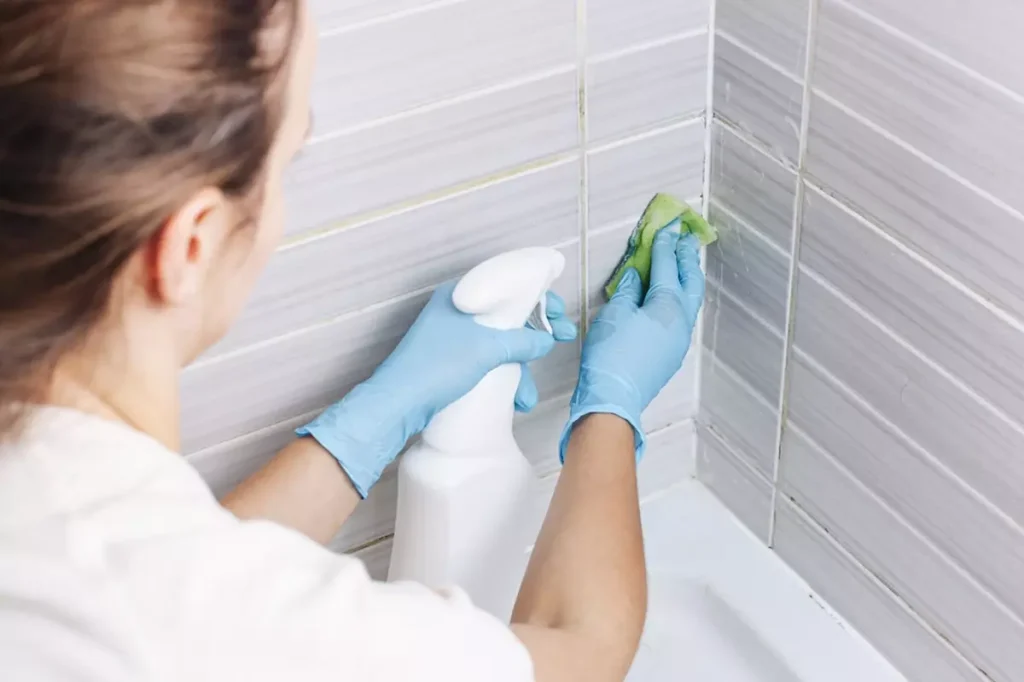
Tiles dull gradually, which is exactly why people stop seeing it. Soap residue leaves a thin film that flattens the colour and makes the whole room read as tired.
Apply a cleaner and let it sit for several minutes before touching it. That dwell time breaks the buildup down, so you scrub far less. Grout lines need the most attention because the porous surface holds dirt that tile does not, and Wirecutter’s guide to cleaning tile grout covers which tools actually help.
Rinse well, then dry with a cloth. Clean tile reflects light, and that is most of why a deep clean makes a bathroom feel brighter.
Step 4: Deep Clean the Shower and Bath
The shower is the hardest-working part of any bathroom, collecting soap scum, body oils and mineral deposits all at once. Apply your cleaner across every surface and leave it while you do something else.
Glass doors and screens
Glass shows the biggest visible change of anything in the room. Buildup here is usually a mix of soap scum and mineral deposits, so it needs dwell time rather than pressure.
Work the cleaner over the whole panel, rinse, then dry it completely. Drying is not optional on glass. Water left to evaporate is precisely what leaves the spots you just removed.
Showerheads and taps
Mineral scale builds inside showerheads and restricts the flow, which people usually blame on water pressure. Descaling restores it.
Fill a bag with descaling solution or white vinegar, tie it around the head so the nozzles are submerged, and leave it for an hour or two before rinsing. Afterwards the spray pattern noticeably improves.
Keep vinegar away from any finish that is not chrome or stainless, though, and check the manufacturer’s guidance first on anything brushed, coated or brass.
Baths and jetted tubs
Freestanding and jetted tubs need descaling as much as showers do. Jets in particular hold residue inside the pipework where nothing reaches, so run a cleaning cycle with a product made for the job rather than hoping a surface wipe covers it.
Step 5: The Toilet and the Area Around It
Clean the bowl with a dedicated product and leave it to sit while you handle the outside, which is the part most often skipped.
Wipe the cistern, the handle, the seat hinges and the full outside of the base. Then clean the floor immediately around it. Odour in a bathroom usually comes from this area rather than the bowl itself, so missing it undoes much of the work.
Door handles and light switches belong in this step too. They are the highest-touch surfaces in the room and almost never get cleaned.
Step 6: Finish With the Floor
Leave the bathroom floor until last so it catches anything that fell earlier.
Sweep or vacuum first, then mop, paying attention to the edges and the corners behind the door. Afterwards, stand back and look at the room properly. A final pass catches the streaks and missed marks that are invisible while you are working close up.
Caring for Marble, Stone and Metal Fixtures
Higher-end bathroom materials need different handling, and the usual advice actively damages some of them.
Natural stone. Marble, travertine and limestone etch on contact with anything acidic. That rules out vinegar, lemon and most descalers and bathroom sprays. Use a pH-neutral cleaner made for stone instead, because the damage from acid is physical etching rather than staining and it does not polish out easily.
Chrome, brass and brushed finishes. These mark with water spots rather than dirt. Wipe and then dry them, and skip anything abrasive, since the scratches it leaves hold future buildup.
Mirrors and glass. A streak-free product plus a dry microfibre finish does more than repeated passes with a wet cloth.
If your bathroom has stone surfaces and you are not certain what is safe, test any product somewhere hidden first. One wrong spray on marble is permanent in a way that no other bathroom mistake is.
Hard Water Is Why San Diego Bathrooms Spot So Fast
This is the part generic cleaning advice leaves out, and it explains a lot.
The City of San Diego reports tap water averaging 16 to 18 grains per gallon, or 272 to 284 ppm. Anything above roughly 10.5 grains counts as very hard, so local water sits well into that range.
Practically, that means every drop left to dry deposits minerals. Glass spots within days of cleaning. Showerheads scale faster. Tiles and taps develop a chalky film that looks like dirt but is not, which is why scrubbing harder rarely shifts it.
Two habits do most of the work against it. Squeegee or towel the glass after showering, which takes about twenty seconds. Then descale fixtures on a schedule rather than waiting until the flow drops.
Coastal humidity compounds it. Homes nearer the water hold more moisture, and older properties across the neighborhoods we serve often have weak ventilation, which is the combination mould wants. Running the extractor for twenty minutes after a shower helps considerably.
How to Keep a Bathroom Clean Between Deep Cleans
A deep clean buys you a reset. These habits are what protect it.
- Wipe surfaces down as you go rather than waiting for a cleaning day
- Run the fan during every shower and for twenty minutes afterwards
- Rinse and dry the shower glass before you get out
- Keep only what you use on the counter, since clutter collects moisture underneath
- Wash bath mats and towels weekly
A written house cleaning schedule makes the weekly part far easier to stick to. For the annual reset, our room-by-room spring cleaning checklist covers the bathroom alongside every other room.
Making a Bathroom Feel Like a Spa
Once a bathroom is properly clean, a few small things change how it feels.
Good towels, laundered properly and folded rather than hung in a bundle, do more than any fixture. Clear counters read as calm, so keep daily items in a drawer and leave the surfaces largely empty. A diffuser, a candle or eucalyptus in the shower finishes it.
None of this substitutes for the clean underneath. Scent over buildup is just scented buildup. Still, after a deep clean these details are what make the room somewhere you want to be.
Deep Clean Bathroom FAQs
Here are the questions that come up most about deep cleaning a bathroom.
How do you deep clean a bathroom step by step?
Clear the room, then work top to bottom. Start with high surfaces, then the sink and drain, then tiles and grout, then the shower and bath, then the toilet and high-touch points, and finish with the floor.
How long does it take to deep clean a bathroom?
Around two to three hours for an average family bathroom. Much of that is waiting for products to work rather than active scrubbing, so you can overlap steps.
What is the best thing to clean a bathroom with?
It depends on the surface. A general bathroom cleaner handles most of it, descaler or vinegar handles mineral buildup on chrome, and natural stone needs a pH-neutral product and nothing acidic.
How do I get rid of hard water stains?
Use an acidic descaler or white vinegar and give it time to dissolve the deposits rather than scrubbing. Keep both well away from marble, limestone and travertine, which they will etch.
Why does my bathroom still smell after cleaning?
Usually the drain or the floor around the toilet base. Both hold residue that surface cleaning misses, and both are easy to overlook.
How often should a bathroom be deep cleaned?
Every one to three months for most households. Shared or heavily used bathrooms sit at the shorter end, and so do homes with very hard water.
Can I use vinegar on bathroom tiles?
On ceramic and porcelain tile, yes. On natural stone tile or stone-look surfaces, no, because the acid etches the finish permanently.
Book a Bathroom Deep Clean in San Diego
A deep clean is a few hours of real work, and it is the kind of job most people put off repeatedly rather than do badly.
Our deep cleaning service covers bathrooms properly, including grout, fixtures and the descaling that local water makes necessary. If the problem is keeping on top of it rather than the reset itself, recurring cleaning is the better fit. After illness, whole home disinfecting goes further than ordinary cleaning does.
Presto Cleaning has cleaned San Diego homes for over a decade, across Hillcrest, Mission Hills, North Park, Normal Heights, Bankers Hill, South Park, Talmadge and University Heights.
Call 619-366-0886 for a free quote, or book a fifteen minute walkthrough.






How did you hear about us?
Pleas let us know how you heard of us
to improve our marketing